


We have a strange relationship with negativity.
On the one hand, we are forever being told to stay away from negativity, think positive, and remove negative people from our lives. And yet, the moment something negative happens, we can hardly look away.
We want the positive.
But we’re curious about the negative.
“Everything is fine.”
Okay.
And?
But say, “Everything was fine, and then something happened…”
Now we pull up a chair.
What happened?
Psychology has a name for this: negativity bias—our tendency to notice the negative more quickly, process it more deeply, and carry it with us longer.
Years ago, psychologist Roy Baumeister and his colleagues published a major review with the wonderfully unsubtle title Bad Is Stronger Than Good. Their conclusion was much as advertised: negative events, feedback, and information often have a stronger and more lasting psychological impact than positive ones.
So it’s not entirely a matter of our own bad temperament.
Some of it is factory settings.
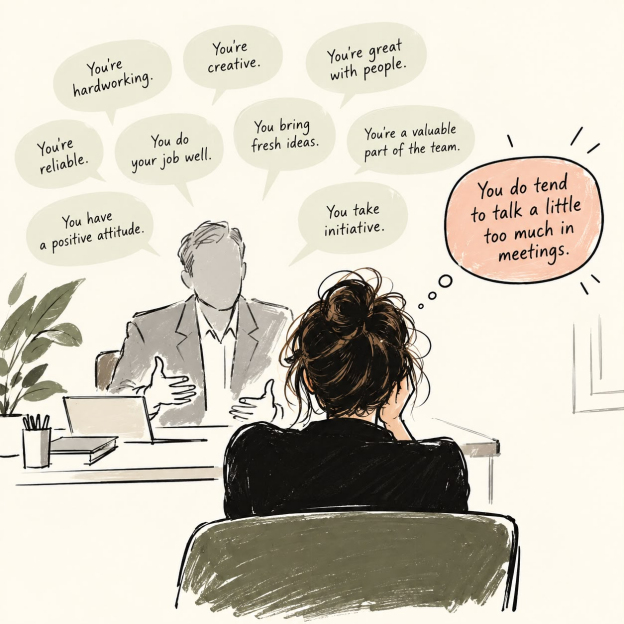
Imagine your boss is giving you a performance review. Nine good things.
You’re hardworking. Creative. Good with people. Reliable. You do your job well.
And then, almost as an aside:
“You do tend to talk a little too much in meetings.”
There you have it.
The nine compliments quietly pack up and go home, while “you talk too much” has already unpacked its suitcase and moved into your living room.
We speed through the positive stations on the express train.
The negative ones? Local service.
Every stop.
Sometimes the conductor even gets off for tea.
There is, of course, some logic to this ancient fascination. The human mind has spent a very long time learning to notice danger, threat, and whatever might be going wrong. Missing the flower behind the bushes was hardly catastrophic.
Missing the tiger was another matter.
The tigers are mostly gone.
The department remains fully staffed.
So instead of scanning the bushes for predators, we inspect the punctuation in a WhatsApp message.
“Okay.”
Why “okay”?
Why not “sounds good”?
No emoji either.
Is something wrong?
Perhaps our real issue with negativity isn’t simply that it bothers us.
It’s that we find it interesting.
We check what the person who annoys us has been up to. We talk about people we claim not to like. We reread bad news. We replay a sentence someone said years ago.
Then we announce:
“I really can’t stand negative people.”
Perhaps.
But apparently, we do find them rather engaging.
Which is why I’ve always found the current enthusiasm for “removing negative people from your life” a little incomplete.
Fine.
You removed them from your life.
Did you remove them from your mind?
Deleting someone from your contacts is easy.
Deleting them from your mental address book is another matter.
More amusing still, in our pursuit of positivity, we sometimes become angry with people we consider negative. We criticize them, dismiss them, perhaps even feel slightly superior to them—and then congratulate ourselves on being positive.
Trying to become positive by hating negative people.
The human psyche never runs out of material.
Perhaps the point isn’t to eliminate negativity from our lives. Clearly, it isn’t going anywhere that easily. It is, after all, an old alarm system.
But we don’t have to evacuate the building every time the alarm goes off.
Maybe what needs a little training isn’t negativity itself, but the attention we lavish upon it.
How long do we look?
How much do we talk about it?
How many times do we turn it over, inspect it, and think it through again?
How many nights do we let one unpleasant thought stay in the guest room of our minds?
Sometimes we carry a single sentence for days. A remark the other person may have made without a second thought gets built, dismantled, and reconstructed in our minds over and over again. They have long since forgotten saying it; meanwhile, we are still examining the tone, the choice of words, the facial expression, perhaps even the atmosphere in the room.
The event is over.
The investigation continues.
And then comes the harder question:
Do we give the good things the same kind of attention?
Can something simply be going well without our immediately adding a “but”? Can we enjoy a beautiful moment without placing it on the examination table? Or are we still speeding through the positive stations on the express train?
Someone compliments us and we immediately object.
“Oh, I’m not that good.”
Someone says something kind and we search for an explanation.
“They were probably just being polite.”
But let someone raise an eyebrow ever so slightly, and we construct an entire universe of meaning behind that eyebrow.
Perhaps being positive isn’t about talking about flowers and sunshine.
Perhaps it is simply about noticing the negative without moving into it.
Acknowledging something unpleasant without allowing it to take over the entire house.
Noticing when something goes wrong, learning whatever there is to learn from it, and then—eventually—being able to close the door.
And perhaps lingering a little longer in front of what is good.
Having a cup of tea there, for instance.
Letting a good day be a good day without interrogating it, searching for what’s missing, or spoiling it with:
“Let’s see how long this lasts.”
Because who knows?
Maybe there really is nothing behind the bushes but daisies.
And we’ve been too busy waiting for the tiger to notice.
Aysen Darcan
Website: aysendarcan.com
Instagram: dr.aysence