


Multidisciplinary Artist / Creative Industries Exper
For many years, performing arts drew their power from an unshakeable, invisible wall: the Fourth Wall. The audience would enter the hall, take their seats, the lights would dim, and the story would begin behind that boundary. The stage was an unattainable universe of illusion, while the audience remained a sterile observer, watching that universe from the outside.
Today, that ancient wall is collapsing with a resounding crash.
The rising new language of performing arts worldwide is no longer just about producing “watchable” works; it is about building habitats that can be entered, smelled, touched, and physically breathed in. The new generation of audiences, in particular, is weary of the two-dimensional illusion created by digital screens. They no longer want to passively admire a well-written script from afar; they want to wander through the capillaries of the story, become an organic part of the atmosphere, and establish a personal, even intimate, connection with the performance.
This transformation is not merely an aesthetic revolution; it is the dawn of a new era that is shaping the future of the experience economy and creative industries.
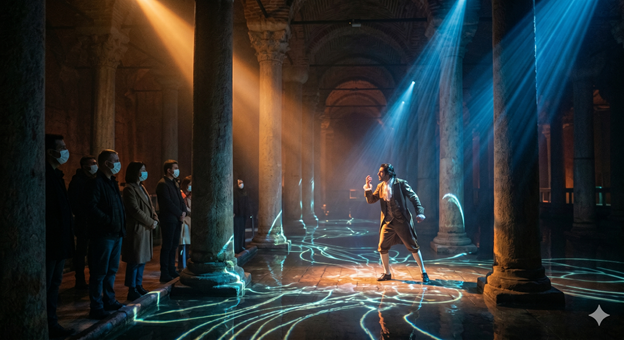
Immersive Theatre: The New Era of Audiences Infiltrating the Story
In recent years, the sharpest rise in the global artistic vision has undoubtedly belonged to immersive theatre. In this model, the audience is torn from their safe seats and left face-to-face with the aesthetics of uncertainty. They wander through labyrinthine hotels, unlock closed doors, breathe in the same corridors as the actors, and sometimes transform into a silent witness—or even a character—capable of altering the course of the narrative.
The space is no longer a backdrop; it is the story itself.
The global manifesto of this movement was written with Sleep No More, the legendary creation of the Punchdrunk collective. Blending Shakespeare’s Macbeth with a film noir aesthetic, the project completely rejected traditional stages, transforming a massive abandoned hotel in New York into a living performance ecosystem. Wearing white masks, the audience roamed freely through this uncanny building. Every room was a memory palace; every corner, another micro-story.
Today, in metropolises like London, New York, Berlin, and Seoul, these experiences have evolved into hybrid formats merging with fashion, gastronomy, music, and digital art.
The pioneering waves of this language are being felt in Turkey as well. Spilling beyond the boundaries of mainstream stages, independent collectives are transforming warehouses, historical cisterns, old peninsula apartments, and industrial hangars into immersive playgrounds.
Because modern audiences no longer seek the comfort of sterile theatre halls, they crave the uncanny reality of spaces with a lived history.
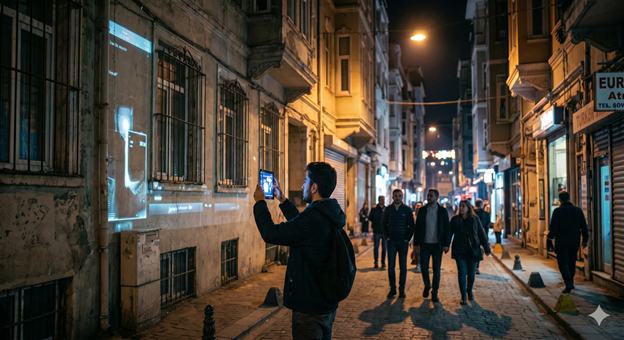
The Flawless Marriage of Technology and Live Performance
The most fascinating turning point of the new generation of performing arts is the dissolution of the boundary between technology and flesh-and-blood live performance. In the past, technology on stage was merely a supporting tool used to adjust lighting or assist set design. Today, it has become the co-creator of the performance—the narrative itself.
Projection mapping, real-time CGI, AI-supported interactive stage systems, motion sensors, and biometric data visualizations are no longer merely elements of spectacle; they are forms of artistic expression.
The teamLab Example: The world-renowned digital art collective transforms physical spaces with living pixels, creating universes that respond to the audience’s steps, breath, and touch. Here, the viewer is not a passive observer; as they walk, digital flowers bloom, and when they stop, the flow of rivers changes direction. The space becomes a living organism, breathing alongside the human body.
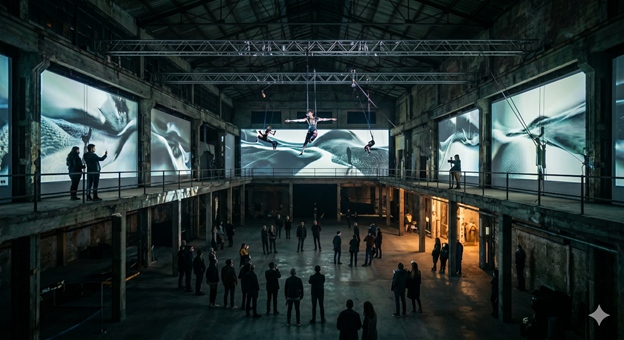
Cirque du Soleil: Reinventing traditional circus arts through technology, the troupe now combines acrobatics with digital narrative systems to evoke a profound sense of catharsis in the audience.
In Turkey, collaborations between new media artists and interdisciplinary theatre collectives are rapidly gaining momentum. In particular, EEG (brainwave) systems, AI-driven live visuals, and video mapping projects are transforming contemporary stages. Performance is no longer an experience perceived solely through sight; it has become bodily, neural, and deeply sensory.
Site-Specific: Bringing the Soul of Space to the Stage
The new generation of theatre is escaping the grand amphitheaters of Ancient Greece and the rigid traditions of Italian stage architecture. The cold concrete floor of a subway station, an abandoned textile factory, a dim hotel room, museum corridors, or a chaotic city street can now become the leading role.
While traditional theatre relies on controlled environments, fixed audiences, and carefully constructed spatial distance, site-specific performance emphasizes lived experience, unpredictability, audience immersion, and narratives shaped by the spirit of the location itself.
The reason for this spatial migration is not merely a search for aesthetic novelty. The “screen fatigue” brought on by the digital age has left people starving for physical reality and tactile experience. Audiences are searching for that raw “sense of reality” within tangible spaces—something the digital world can no longer fully provide.
In Turkey, visionary organizations such as DasDas and Paribu Art, alongside independent interdisciplinary initiatives, are feeding this hunger through compelling alternative-space productions.
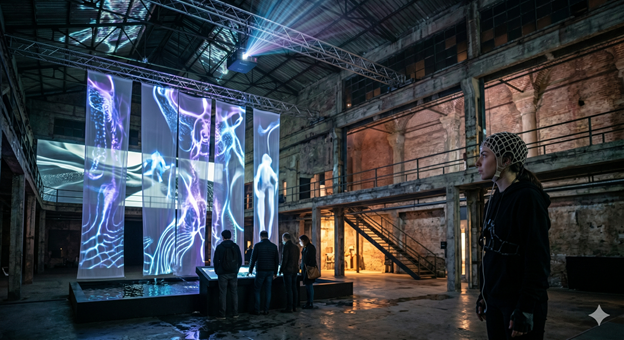
From Director to “World-Builder”: Interdisciplinary Art
The stage language of the new era is too liberated to accept the hegemony of a single artistic discipline. Theatre, contemporary dance, installation art, live music, video art, haute couture fashion design, and architectural sound design now dissolve into one another.
This shift has also disrupted traditional theatre terminology. The concept of a “director” solely responsible for the text is no longer sufficient to define these projects. Today’s creators increasingly identify themselves with titles such as World-Builder, Experience Designer, and Creative Director.
At global platforms such as the Venice Biennale and SXSW, a fashion runway can transform into a massive theatrical spectacle, while a concert can evolve into an immersive digital art installation.
The new generation of creators in Turkey is also moving beyond the cliché of simply “staging a play” or “opening an exhibition,” choosing instead to construct entirely original experiential universes.
The Active Participant: The Audience’s Rebellion against Passivity
Perhaps the most radical transformation has taken place in the role of the audience, which for centuries sat silently in the dark. The passive, applauding spectator of the old world has been replaced by the “spect-actor” — an active participant who makes decisions, chooses directions, influences the course of the story, and leaves behind digital or physical traces within the performance.
For Generation Z and Alpha in particular, who place experience at the center of their lives, art is no longer simply a commodity to be consumed; it is something to be personalized, lived through, and embedded into collective memory.
The most powerful and enduring projects of the future will not merely be those that tell compelling stories flawlessly. The future belongs to experience designers capable of creating works that are technologically seamless, interdisciplinary, physically immersive, and above all, profoundly human.
Because art is no longer a painting we stand before and admire from a distance; it is a world we step into, lose ourselves within, and emerge from as someone transformed.
RU Ceylan
Multidisciplinary Artist / Creative Industries Expert