

Can a smaller fair create a stronger impact?
Art Basel’s 2026 Miami Beach edition arrives with a tighter floor plan, fewer galleries and a redistributed map of influence. The decision may signal more than financial pressure; it could also mark the limits of the mega-fair model.
ARTTMODERNMIAMI Gazette • October 2026
What does it mean when an art fair gets smaller?
Art Basel Miami Beach will take place at the Miami Beach Convention Center from December 4 to 6, 2026. Its announced exhibitor list includes 272 galleries from more than 40 countries and territories. The number still looks enormous, but the real story is the fair’s deliberate decision to tighten its footprint rather than expand it.
According to the organizers, the fair’s overall footprint will shrink by roughly 12 percent, while the main Galleries sector will contract by about 10 percent. Participation in that section falls from 226 galleries last year to 204 this year. The shift suggests that the contemporary art market is confronting not only sales volume, but also the attention economy, rising logistics costs and visitor fatigue.
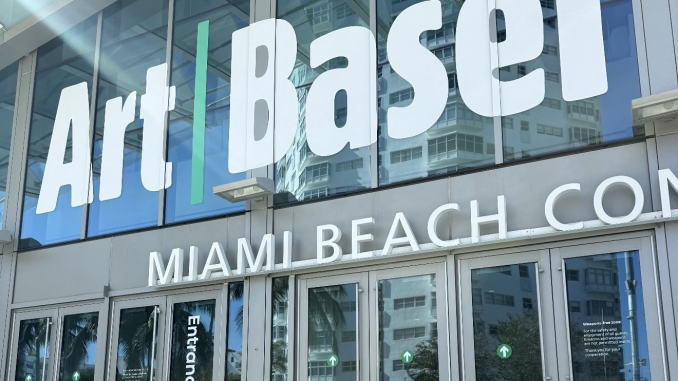
Entrance to Art Basel Miami Beach. Photo: ARTTMODERNMIAMI archive.
The new layout aims to improve the visitor experience through shorter routes and clearer areas of focus. Yet the meaning of this contraction is not merely architectural. When an art fair reduces its square footage, it also reshapes who remains visible, who is pushed to the margins and which regional narratives gain strength.
The center disperses, and competition is redrawn
One of the most striking aspects of the 2026 plan is the decision to distribute major blue-chip galleries throughout the hall instead of clustering them along a single prestige corridor. Physically breaking up the center of power could give smaller and mid-sized galleries greater visibility. It may also encourage visitors to navigate the fair as a field of discovery rather than a map of status.
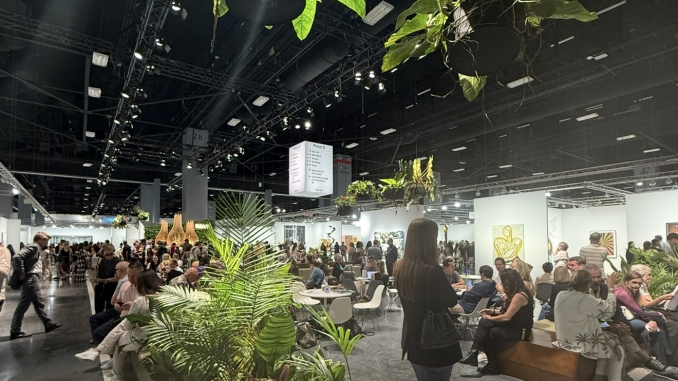
Visitor flow and communal areas inside the fair. Photo: ARTTMODERNMIAMI archive.
The new arrangement will not erase the market hierarchy. It does, however, remind us that architectural decisions shape commercial behavior: a collector’s route, the galleries placed next to one another and even the location of seating areas can determine which works are seen. The fair is therefore designing more than a space; it is managing the circulation of attention and value as if it were a curatorial medium.
The contraction also reinforces the claim of greater selectivity. In theory, fewer booths can create a denser experience and a clearer editorial spine. But that claim will only be credible if new participants are supported as equal actors in sales and visibility, not merely displayed as evidence of diversity.
A new center of gravity for Latin America and the Caribbean
Miami’s geographic and cultural position has long made the fair a strategic gateway for Latin America and the Caribbean. The stronger visibility of this axis in the 2026 selection is more than a gesture toward regional representation; it is a structural sign that the global art market now has multiple centers of gravity. Brazil’s emergence as the third-largest national contingent is especially significant in this context.
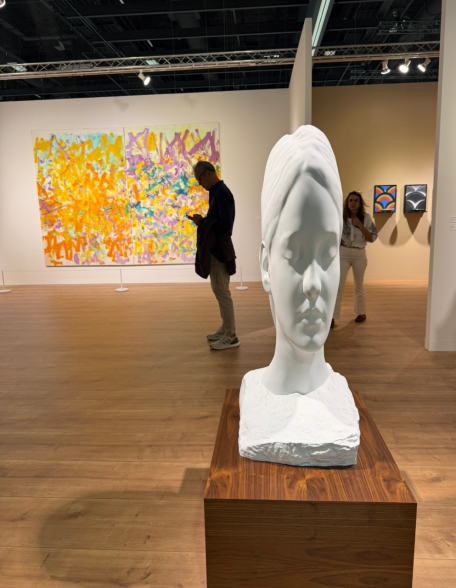
Installation view at Art Basel Miami Beach. Photo: ARTTMODERNMIAMI archive.
Still, the numbers only tell part of the story. If regional visibility is to last, galleries must enter circulation networks, museum programs and collections beyond fair week. Miami’s role should not be limited to bringing works together for a few days; it should help build longer-lasting connections among distinct art ecologies.
Digital art, climate and new forms of experience
The fair’s Zero 10 program reopens the conversation about the boundary between digital production and physical space. The presence of artists such as Refik Anadol, whose work engages data, artificial intelligence and immersive imagery, shows that technological practice is no longer confined to a separate innovation category; it has become one of contemporary art’s central currents.
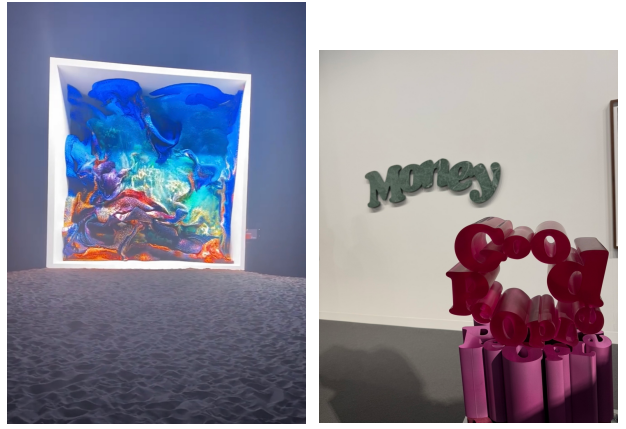
Refik Anadol’s beach installation and an installation view from the fair: digital experience meets the language of the market. Photos: ARTTMODERNMIAMI archive.
In Miami, technology cannot be considered separately from the climate crisis. The sea, the light, the coastline and urban vulnerability place the aesthetic appeal of digital work beside a very real ecological tension. A successful program must treat technology not simply as a spectacular surface, but in relation to energy use, data politics and environmental responsibility.
A sign of weakness, or a strategic redesign?
Given the art-market slowdown, rising logistics costs and widespread fair fatigue, contraction can be read as an economic necessity. Yet Art Basel Miami Beach is pairing reduced scale with experience design. The real measure of success, then, will not be visitor numbers or total sales alone, but whether the fair can produce more meaningful encounters within a smaller footprint.
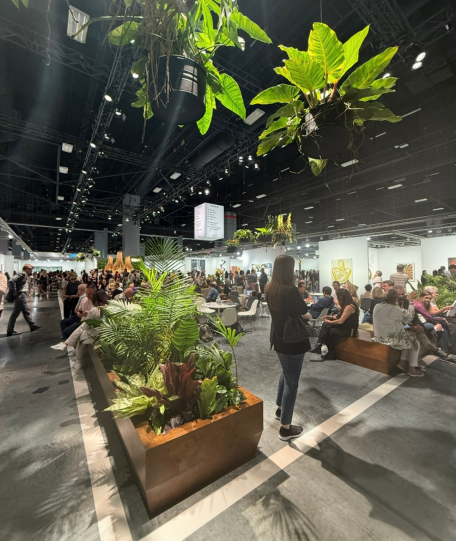
Galleries, visitors and seating areas converge within the fair’s dense ecosystem. Photo: ARTTMODERNMIAMI archive.
The future of major art fairs may depend less on perpetual expansion than on better selection. Shorter routes, slower looking, stronger context and the possibility of genuine discovery… The 2026 edition will test whether Miami can become not only a showcase for the art market, but also a laboratory in which the fair model itself is redesigned.
The art world’s invisible workforce
Whitney workers prepare to strike
Workers at New York’s Whitney Museum of American Art have voted to strike on October 5, 2026, if a fair collective bargaining agreement is not reached. Represented by UAW Local 2110, the employees are focused on wages and healthcare costs; the union is seeking a minimum salary of $71,000.
A possible strike could affect previews of the Roy Lichtenstein retrospective scheduled to open on October 11. The dispute brings renewed attention to the tension between museums’ public prestige and the working conditions that make that prestige possible. The ethical claims of art institutions are now measured not only by the work they exhibit, but also by the conditions they provide for their employees.
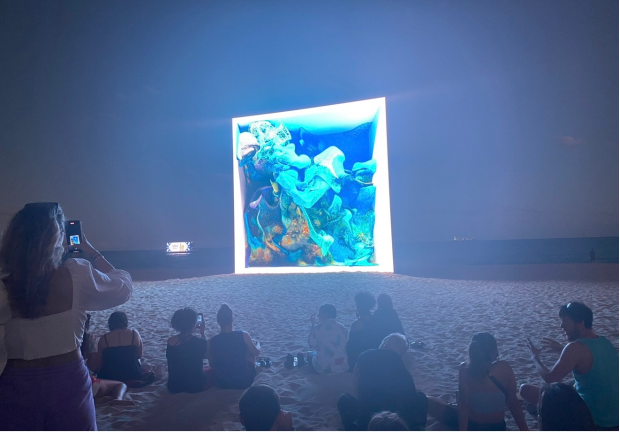
Refik Anadol’s beach installation moves the art experience beyond the fair hall and into Miami’s public and natural environment. Photo: ARTTMODERNMIAMI archive.
Sources
• Art Basel — Miami Beach 2026 exhibitors and the new floor plan
• The Art Newspaper — Art Basel Miami Beach’s reduced floor plan