
Art Basel Paris’s early shutdown raises a question about the art market that extends beyond visibility and sales to the distribution of risk.
October 25, 2026 | News analysis
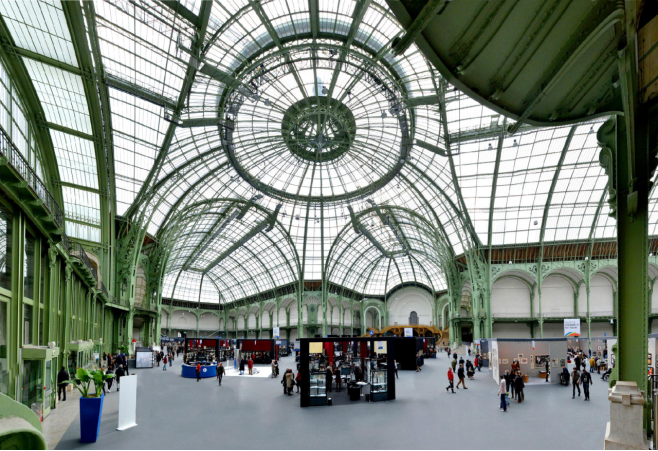
The glass-roofed hall of the Grand Palais. Archive photograph; not the 2026 edition.
When the final two days disappear from an art fair’s calendar, more than viewing time is lost. A collector expected over the weekend, a first face-to-face meeting, a painting someone planned to see again: these unfinished encounters never appear on a sales report. They are part of what remained behind the closed doors in Paris.
Following an announcement on October 22, Art Basel Paris ended its 2026 edition at 7 p.m. on Friday, October 23. The October 24 and 25 program was canceled because of anticipated protests and security concerns. Organizers cited the protection of visitors, exhibitors, staff, and artworks. [1, 5]
The decision leaves an economic question: Do booths that close at the same moment experience an equivalent loss? The sources reviewed for this article do not provide a verified account of total gallery losses. What the closure does offer is a concrete reason to examine how the fair model distributes exposure to risk.
Not everyone works on the same timetable
In its October 22 report, Ocula relayed White Cube’s announcement that it had sold two Julie Mehretu paintings for $7.85 million each. The report also highlighted differing gallery needs within a preview system focused on increasingly selective groups of buyers. These figures came from gallery reports; they were not an audited measure of the fair’s overall financial health. [2]
A gallery with an established client network may complete an important negotiation before the crowds arrive. For another gallery, the weekend may be when the work of meeting new buyers begins. That distinction is an analytical starting point, not a finding that can be applied uniformly to every Paris exhibitor.
Speaking to Le Monde, Nathalie Obadia emphasized the weekend’s importance for collectors arriving from the French regions and neighboring countries. [3] Treating the final days as economically secondary risks overlooking those visitors and the galleries whose business depends on reaching them.
Fewer sales opportunities do not erase existing costs
A fair budget can extend well beyond the booth fee. Shipping, preparing artworks, insurance, staff time, accommodation, and installation may all form part of the investment. How an early closure changes those expenses depends on each exhibitor’s contracts and arrangements. Losing two days does not establish an identical percentage loss for everyone.
The essential distinction is between a reduced opportunity to sell and the disappearance of costs already incurred. An expected transaction may never happen, but assessing the damage does not justify assuming that the sale was certain. A conversation might also continue after the fair. A careful account needs to separate missed opportunities, actual expenditure, and transactions completed later.
For a small gallery, that uncertainty could mean revisiting the budget for its next exhibition. A business with greater financial reserves may absorb the same interruption more easily. Establishing what happened to particular exhibitors requires their accounts and testimony. Size alone cannot tell us who lost the most; it can help us ask who has the capacity to withstand a disruption.
Clear terms matter alongside safety
Examining the economic consequences of a safety decision does not diminish the importance of protecting people. An organizer’s responsibility and an exhibitor’s financial exposure belong in the same discussion.
Domus reported on October 23 that details of potential compensation for exhibitors had not been provided. [4] That should not be turned into a claim that no assistance will be offered. As of October 25, the sources reviewed do not establish the scope of a compensation arrangement applying to all galleries.
This is where the terms of participation matter. Is there a refund for unavailable days or a credit toward a future edition? Who pays additional costs if shipping schedules change? What losses does the insurance cover? Answers should be understandable before a crisis. The point is to improve the information behind a participation decision, rather than to offer a legal conclusion about any particular contract.
The question Paris leaves for Miami
As Miami Art Week approaches, Paris deserves attention beyond a disrupted cultural itinerary in another city. Galleries and artists need to weigh a fair’s promise of access against the financial exposure they accept. Organizers should explain their responsibilities in a crisis as clearly as they communicate the prestige of taking part.
For an artist, the implications may extend beyond fewer hours on display. A chance to reach a new buyer, meet a curator, or begin a conversation about a future exhibition also belongs in the assessment. Not every encounter can be assigned a price, but those possibilities should remain visible when discussing a fair’s cultural value.
The early end in Paris exposes the limits of describing the art market through its most expensive transactions. A fair’s strength should also be judged by the working conditions it offers galleries at different scales. Once the doors close, a question remains: Do the people who create the opportunity together also share the risk?
Sources
1. The Art Newspaper — Gareth Harris, 22 October 2026
2. Ocula — Naomi Rea, 22 October 2026
3. Le Monde — Roxana Azimi, 22 October 2026
5. Art Basel Paris — Visitor information
Sources checked October 25, 2026. This analysis draws on published reporting and the organizer’s announcement. Gallery comments are attributed to the reporting outlet; they are not original ARTTMODERNMIAMI interviews. No unverified totals for losses, insurance coverage, or exhibitor compensation have been used.
Photo Credits and Licenses
Cover: Grand Palais Interieur — David Pendery, 2014. Wikimedia Commons. CC BY-SA 4.0 | Original photo and attribution
In the article: Exterior of the Grand Palais — ssedro, 2015. Wikimedia Commons. CC BY-SA 2.0 | Original photo and attribution
Photographs are reproduced without cropping. Licenses apply to the photographs; adaptations require the same or a compatible license. Checked October 26, 2026.