


By the end of the day, I found myself coming to a simple conclusion.
No matter what you do.
No matter what you say.
No matter how you respond.
Protect your grace.
I’m not sure how much has been written on grace. I certainly don’t come across it very often in psychology. We keep hearing the same advice: Be assertive. Be confident. Set boundaries. Express yourself. Be self-aware.
All of it has its place, of course.
Yet it feels as though one quiet virtue has somehow slipped away.
Be gracious.
Perhaps the word itself has fallen on hard times. For some people, grace evokes delicate manners or refined etiquette. For others, it suggests someone passive, timid, almost invisible.
I’ve come to believe the opposite.
Grace has always felt to me like strength at its quietest.
A dear friend mentioned figure skating competitions to me recently and how skaters receive both technical and artistic scores.
“I never really understood how they judged the artistic score,” she said.
It made me wonder whether life does something similar.
We all have technical scores.
Doing our jobs well.
Keeping our promises.
Managing the practical business of living.
However, perhaps we also have an artistic score.
Giving the largest bill in your wallet to someone in need.
Refusing to let the driver who cuts you off steal your peace.
Not feeling the need to raise your voice simply because you’re right.
Carrying a small pocket of calm within you, even when everything around you feels hurried.
In my early twenties, during my first years as a doctoral student in the United States, one of my professors stopped me in the hallway.
“We were just talking about you,” he said.
Then he simply said,
“You have a wonderful way of carrying yourself.”
At the time, I didn’t fully understand what he meant. Nevertheless, for reasons I couldn’t explain, that sentence stayed with me.
For years, I found myself returning to the same question:
How does a person carry himself or herself?
Sometimes other people notice something in us long before we do. Moreover, every now and then they say it in passing—in a hallway, between conversations—with no intention of impressing us or changing our lives.
Perhaps that’s precisely why those moments stay with us.
They aren’t trying to accomplish anything.
The expression “carry yourself” is difficult to explain because native speakers hardly think about it.
Yet it means so much more than posture or appearance.
It’s how you walk into a room.
How you look at people.
How you use your strength.
What you do when you’ve been hurt.
Who you become when you’re right.
How you carry your silence.
In other words, it is the way you carry your very presence.
In addition, perhaps that isn’t something we consciously learn.
It isn’t something we perform.
Who we are on the inside eventually finds its way into the world.
Maybe that’s what grace really is.
Not simply the way we carry ourselves, but the way we carry our strength, our knowledge, our pain, our certainty, and even our silence.
Of course, none of this was clear to me in my twenties.
I certainly wouldn’t give my younger self too much credit.
However, that sentence quietly kept me company all these years.
Over time, I’ve come to realize that our deepest education isn’t knowledge.
Knowledge can grow endlessly, but if it doesn’t make the way we carry ourselves more beautiful, experience alone is never enough.
Humility, I’ve learned, suits grace beautifully.
Much like fresh dill sprinkled over zucchini or artichokes.

It never takes over the dish.
It simply completes it.
Perhaps that’s what growing older really means.
Not taking up more space in the world…
Nevertheless, leaving a little less weight behind wherever we stand.
Life taught me how to speak. How to listen. How to be a therapist.
However, looking back, I don’t think those were the greatest lessons after all.
With age, I hope we learn not simply to speak more wisely, but to carry ourselves more beautifully.
Only now do I understand why that sentence has stayed with me for so many years.
Grace, perhaps, is simply the outward elegance of inward maturity.
Maybe that’s why certain people leave us feeling lighter.
They don’t offer profound advice.
They don’t need to prove themselves.
Their presence never shouts.
Yet somehow, after they’ve gone, something inside us has softened.
We leave feeling just a little quieter.
A little kinder.
A little more human.
Lately I’ve found myself entertaining a mischievous thought.
I wonder if God keeps technical and artistic scores too.
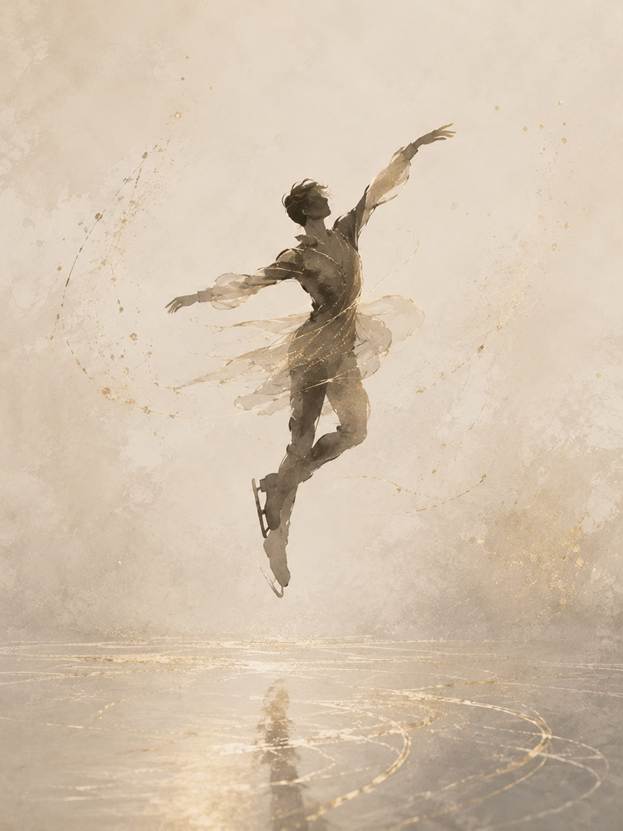
Perhaps, in the end, only the artistic score remains. The triple Axel was beautiful… but what about the landing?
Aysen Darcan
Website: aysendarcan.com
Instagram: dr.aysence