

Country of the Sweet Life in the Mediterranean
When you think of Italy, what comes to your mind? Historical richness, natural beauty, art, music, food, fashion, sports cars, fast-talking, cheerful, friendly people, right? The list goes on and on… Geographically speaking, one of its nicknames is “the boot” because it resembles a boot on the map. Another is “Bel Paese,” meaning “beautiful country.”
I had the chance to visit Italy again this summer, a country I have visited several times before and that I love very much.
My first stop was Milan. I spent a few days in Milan, one of the capitals of fashion, which boasts the finest examples of art, history, and Italian cuisine. I mainly used public transportation because it is very well developed in Italian cities and is more economical, so I chose it.
On the first day, I took the train and metro from the airport to the city. After checking into the hotel, I took the metro to the famous Piazza del Duomo. Duomo means “cathedral” in Italian. There were long queues in front of the Duomo di Milano, the number one tourist attraction in Milan. It was possible to get tickets in advance to enter, which meant you could see both the museum and the terrace with less waiting.
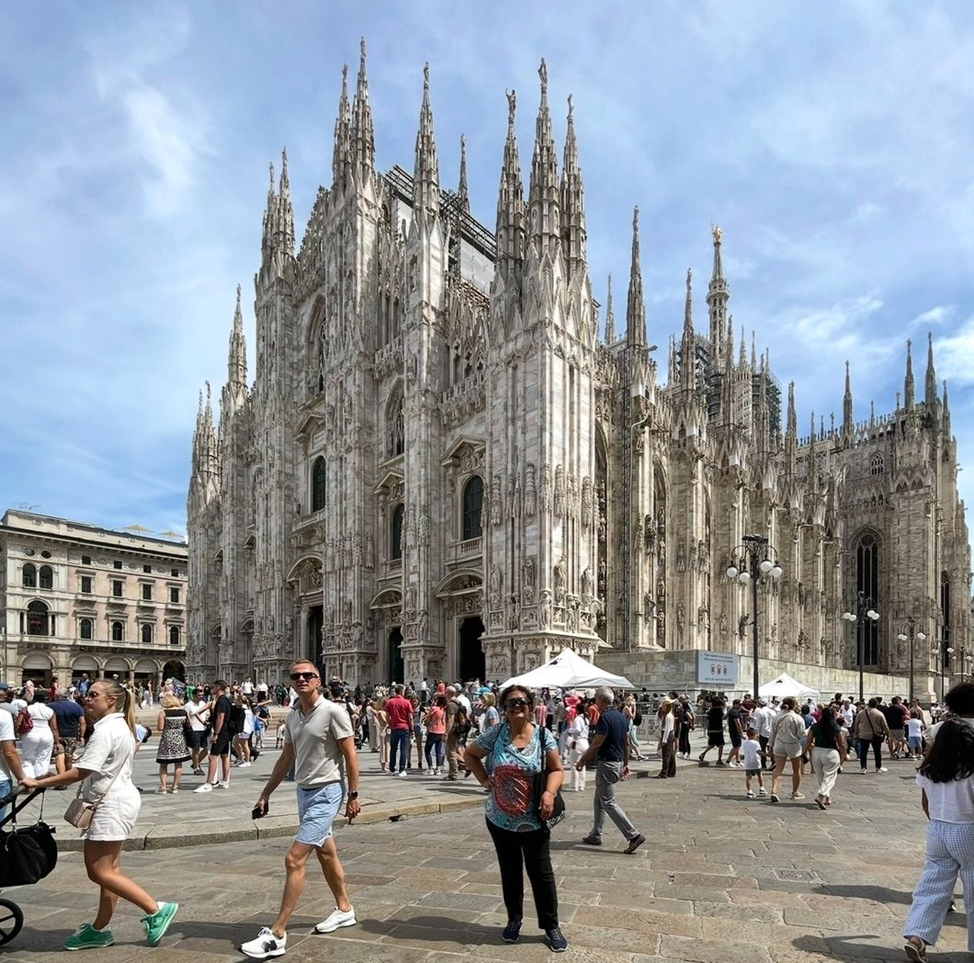
Construction of the cathedral, which houses around 4,000 statues, began in 1386, and the construction of the building, famous for its Gothic architecture, took about six centuries. There are also many sculptures and figures on the exterior of the building. The most famous sculpture is the Madonnina (little Madonna) statue located on the terrace. Placed there in 1774, the statue represents the Virgin Mary and is a symbol of the city.
The Galleria Vittorio Emanuele II, located right next to the cathedral, is considered one of the oldest shopping centers in the world. The gallery houses boutiques of luxury brands such as Prada, Gucci, and Louis Vuitton, as well as restaurants, cafes, and a hotel. I was very impressed while exploring it because the Galleria Vittorio Emanuele II was not only a great place to shop but also a place to discover Milan’s historical and cultural heritage.
The symbols of Italy’s four capitals—Milan’s red cross, Rome’s She-Wolf, Florence’s Lily, and Turin’s Bull—were depicted as mosaics on the floor. There was a long line in front of the Turin Bull.
According to legend, if you press a specific point between the bull’s hind legs and count to three, it brings good luck. This ritual has become quite popular among tourists. Actually, this tradition is frowned upon because it damages the mosaic, but many people still want to try it. Of course, I didn’t hold back, and I spun around three times on the mosaic while making a wish.
I saw the statue of Vittorio Emanuele II, Italy’s first king, and sat in its shade for a while. The area was full of birds, and they had left droppings on the statue. The square also had the Leonardo da Vinci Museum and the Novecento Museum. I didn’t have time to explore them inside; I was too tired and hungry. While wandering the back streets of the square, I found a charming cafe called Middle Bistro. I satisfied my hunger Italian-style with panzerotti, a dough dish filled with tomatoes and mozzarella, and an espresso. Italy’s first Starbucks was also within walking distance, but it was so crowded that I couldn’t buy anything there. I toured the coffee shop, which was like a coffee factory, and then headed back out onto the streets.
I paid 3.5 euros for ice cream from Dante Cafe, but the owner wouldn’t let me sit inside. It turned out I had bought the cheaper option, which meant I didn’t have the right to sit in the shop. This practice exists in Italy: if you sit down and eat there, you pay a little more; if you don’t sit down and take it to go, you pay less. I found a solution with my practical wit: I sat down outside the shop, where the owner couldn’t see me, and enjoyed my ice cream.
If you go to Milan, be sure to visit San Bernardino alle Ossa, one of the most interesting churches in the world. In the 1200s, when cemeteries became insufficient, human bones began to be stored in ossuaries, and then a church was built. These ossuaries are arranged in religious motifs and have become a striking example illustrating the transience of life.
While walking around the market, I also saw the Milan team’s sports store. There was a large crowd waiting inside because a famous athlete was there. Television crews and people were standing at the door with their phones. Later, I walked towards Sforza Castle. Inside this medieval castle was the Museo della Pietà Rondanini, which housed Michelangelo’s last sculpture. He passed away before completing his work, the Pietà Rondanini.
I walked through Sempione Park and reached the Arco della Pace at the end of the road. Built to celebrate Napoleon’s victories and the peace brought by the Congress of Vienna, the Peace Arch featured a statue of a chariot of war symbolizing peace.
I then took the tram to the Navigli district. The canal district, originally built to transport marble to the Duomo, is now known as a place with Milan’s vibrant nightlife. Along the Naviglio Grande and Naviglio Pavese canals, there were restaurants, bars, antique shops, and souvenir sellers, most of whom were Pakistani, Bangladeshi, and Indian. I did a little shopping, bargaining a bit. The Navigli district, where Milan’s entertainment venues are located, was full of tourists. The famous Italian drink Spritz was 5 euros here, but of course, you’d pay more if you sat down to drink it.
On the way back, I got off the metro at the Duomo stop again and saw the cathedral this time with its night-lights. The hotel I stayed at was an interesting place consisting of sleeping pods. I wanted to have a different experience, but getting in and out of the pod, sleeping, and getting dressed was quite difficult.
The next morning, I woke up very early and had breakfast at the hotel. Since the train was undergoing repairs and the trams would take a long time, I took an Uber to Garibaldi Station. Today I had booked a tour of Lake Como. I found the guide and the other passengers. The staff handed out walkie-talkies and headphones. Our guide, speaking with an Italian accent, began the tour. When we pressed the blue button on the device in our hands, we could hear the guide’s voice. I grabbed a window seat on the bus. Our guide, Amato, introduced us to our driver, Claudio. He gave us information about the Milan and Como tour.
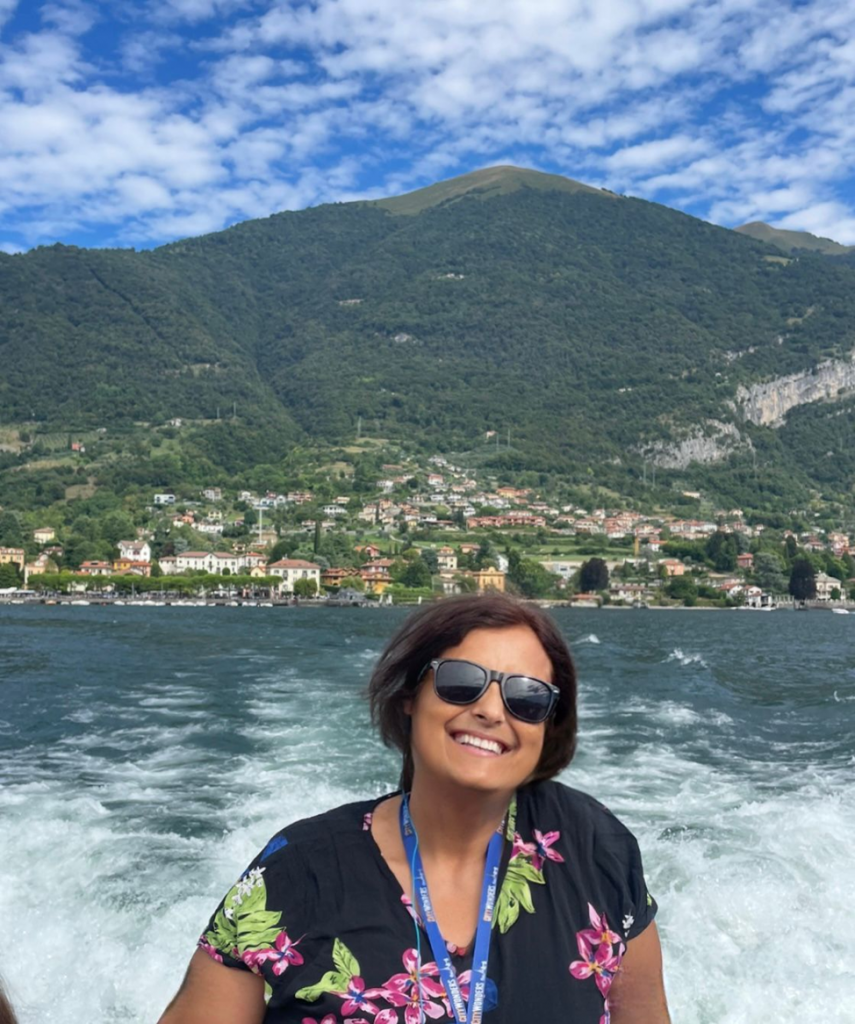
stopped at a gas station for a break. When we set off again, Amato said, “Get your cameras ready; you’ll see Lake Como on the right.” After passing through a few tunnels, the magnificent views of Lake Como, Italy’s deepest lake began. We also passed through the outskirts of the city. People work here and then go to their homes in the coastal towns. After Covid, the places where the local people live have become more expensive.
Amato also pointed out the house of famous actor George Clooney, joking, “He bought it 20 years ago for 10 million; now he wants to sell it for 100 million euros because he’s bothered by the paparazzi. If you have 100 million, you should buy it.”
After passing through the town of Angelo, located at the deepest point of Lake Como, we got off the bus and boarded a boat. We listened to the guide’s information through headphones. He showed us the houses where films like James Bond: Casino Royale, Star Wars II, House of Gucci, and Murder Mystery were filmed. He shared information such as, “Weddings are also held here, and you go there by private boat.”
Villa del Balbianello, where Anakin and Padmé met in Star Wars: Episode II – Attack of the Clones, was particularly worth seeing. After enjoying the lake’s beautiful scenery and magnificent villas, we arrived at the famous town of Bellagio. We disembarked at the pier in front of the San Remo Restaurant, where we had free time. I first walked to the right side of the island. I saw the ferry queue heading to the opposite shore. Walking along the flower-decorated coastal road, I rested on the benches because it was very hot and tiring. I walked all the way to the end, where there was a beach and an amusement park. The restaurants were full. The front of the truck selling Panini, a type of sandwich, was very crowded.
Then I walked to the other side of town. I wandered around the market and saw an area with small, charming hotels, most of them accessible by climbing a hill. I sat down at the San Remo restaurant and had a coffee. We got in line with the group and boarded our boat. Our guide, Amato, thanked Captain Paolo on our behalf. We waited for the bus on the shore and set off again.
We drove through scenic narrow bends. Amato said, “This time, those sitting on the left will see the beautiful view.” We saw Lake Lugano, shared by Italy and Switzerland, with its beautiful houses and villas with helipads. The roads were very narrow and did not allow two-way traffic, so cars were waiting with their lights on. Indeed, we came face to face with a big truck. It backed up and drove up a small hill to let us pass.
Amato joked, “You can drink cappuccino in Lugano. It’s illegal to drink it in the afternoon in Italy, but you can drink it there. The euro isn’t accepted there. If you pay in euros, they’ll give you change in francs. So pay with a credit card. You’ll notice that the prices are higher anyway.”
There were no police at the border. We knew we had crossed from Italy into Switzerland when the flags changed. We got off in front of a fountain with jets near Burger King in Lugano. First, we walked together. The guide took us to the city center. We listened to information about the city through our headphones. We saw the historic town hall. He pointed to the shopping street and joked, “Via Nasso is Lugano’s most dangerous street.” He was referring to the expensive brands sold in the ultra-luxury stores.
In my free time, I went to the Church of Santa Maria degli Angeli. Bernardo Luini’s paintings, copies of The Last Supper, adorned the walls of this church. After seeing these three paintings, considered the best copies of Leonardo da Vinci’s Last Supper, I walked along the shore and took pictures. There were boats and pedal boats on the lake. I was once again enchanted by the politeness of the Swiss people and the cleanliness of their cities.
Later, I met up with the group and got on the bus. Our return trip was via the highway, and it was faster. This time we saw border police. Traffic was heavy at the border, so it took a long time to cross. Although they didn’t check passports, we moved slowly because of the traffic. No one tipped when we got off. The guide didn’t ask for a tip for himself or the driver. I thought that if this were in America, he would have made an announcement asking for one.
I took the tram to Porta Venezia and had a margherita pizza, cola, and tiramisu at the Venus Restaurant, which only cost 15 euros. In America, such a meal would be very expensive and upset my stomach, but here, everything is organic, so the food was healthy and delicious. I went to the hotel and rested.
The next morning, I went down for breakfast around 8 a.m. While enjoying tea and coffee, I planned my itinerary for Florence. I decided to go by bus and bought a FlixBus ticket for 13 euros. This time, I didn’t buy a ticket on the way to the bus station by metro and used my credit card instead. I paid with my credit card both when entering and exiting.
Since Florence is called “Firenze” in Italian, I looked at the signs for buses going in that direction, found my bus, and got on. I was comfortable sitting alone until Parma. After Parma, three Italian women came and sat next to me. The woman sitting right next to me didn’t stop talking the whole way. She kept getting off at rest stops to smoke what she called “sigaretta.” The free internet on the bus had a limit. I used it a little, and it ran out. In short, bus travel in Italy isn’t very comfortable; I wouldn’t recommend it.
Finally, I arrived in Florence. I got off at the bus station, Villa Costanza Firenze. It was late, so I tried to take tram T1 to the city center, but I needed to transfer to bus number 46 to go to the hotel that I had booked online. I waited quite a while at the stop; there were other people waiting too.
When a huge flying bug appeared, everyone screamed and ran away. The bug flying onto my hand, me screaming and throwing it on the ground, and one of the young people waiting at the stop squashing it became an unforgettable memory of the night. Because of this incident and the long wait, I gave up on the bus and took an Uber to the hotel. At the hotel, I caught a chill from the air conditioning and felt uncomfortable. My days in Florence began with an adventure.
The next morning, I had breakfast in the hotel garden by the pool. Italian breakfasts consisted of croissants, cakes, fruit, eggs, and salami. Unlimited food, tea, and coffee for 10 euros was very reasonable. Then I started walking towards the city. I found an open market. Bags and souvenirs were being sold on both sides. The Mercato Centrale Firenze, a covered market, sold food and had restaurants. I was overcome by the heat in the Centro Storico. I sat down to cool off at the entrance of a building called “Artist.” Opposite, I saw the famous San Lorenzo Basilica. The tombs of the famous Florentine Medici family and the Medici Chapel were also located here.
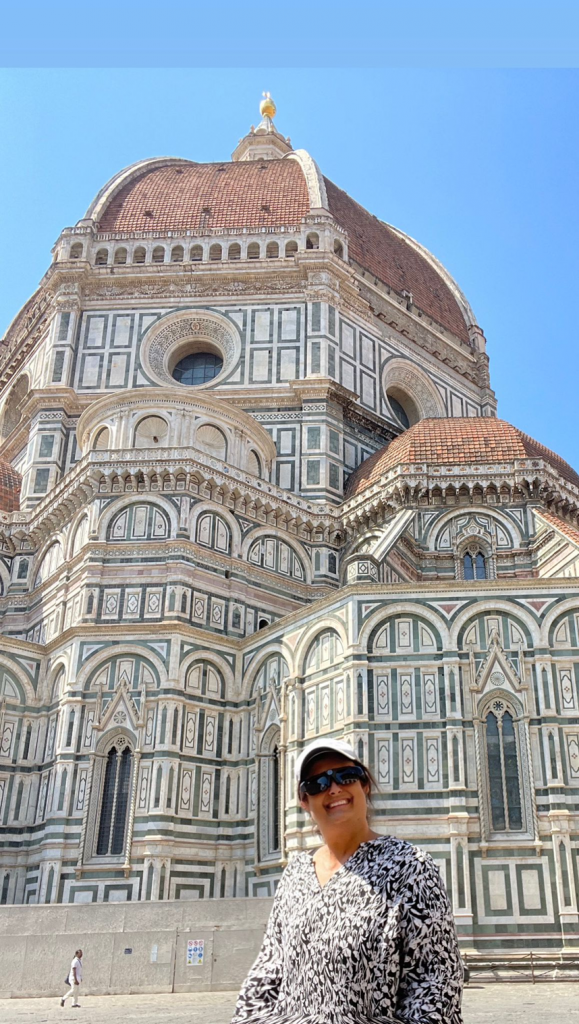
resting a bit, I walked to Florence’s largest and most important building. The Florence Cathedral, or Duomo, stood before me with its white marble facade and statues. It cost 30 euros to climb the 360 steps to the top. Painters were drawing portraits in front of it.
Right across from it was Giotto’s Bell Tower. Entry was free, but it was very crowded. Since they didn’t allow bags, you had to either leave them at nearby shops for a fee or leave them at the hotel. I couldn’t trust anybody to take my photo because Italy is notorious for thieves, so I asked a souvenir shopkeeper. Later, I did some souvenir shopping. I had trouble finding the hotel on the way back because I didn’t have internet. When I got to the hotel, I changed rooms. I went to the pool. I cooled off in the water, which flowed like a waterfall, and sunbathed.
My surroundings were filled with tourists from all over the world. I changed my clothes for the evening and took the elevator up to the fifth floor. At the rooftop bar, two men, one young and one older, were playing music. The older one, with a voice reminiscent of Sting, sang popular songs from the eighties and nineties. The cathedral and other historic buildings were visible in the distance. I drank an Italian Spritz. So, having enjoyed a nice Italian evening, I returned to my room.
Next day, after breakfast in the morning, I checked out and left my suitcase in storage. Hotels in Italy generally don’t offer free storage. I paid a 3-euro storage fee here. I booked a train and a hotel in Rome for tonight. Then I started walking and found St. Mark’s Square. I passed by the Riccardi Medici Palace and the Baptistery of San Giovanni and arrived back at Duomo Square. This time, a young man was singing opera in front of the cathedral. He had a beautiful, trained voice. After the concert, I went over and talked to him. He said he used the Instagram account “Opera on the Street,” that he was Russian, and that he spoke English, Italian, and German. There was a carousel in Piazza della Repubblica. They were taking tourists for rides in tiny cars. After charging my phone at the Apple Store and cooling off, I visited the Florence Hard Rock Cafe. At the La Piedineria restaurant, I ate a type of wrap called “solare,” which contained tomatoes, mozzarella, peppers, salami, and lettuce. The owner of this place and the luxury restaurant next door was the famous Italian artist Sophia Loren.
The palace, museum, statues, and fountain I saw in Piazza della Signoria really impressed me; it was like an open-air museum. I took a photo with the giant black girl statue holding a cell phone. Then I toured the Palazzo Vecchio. The water flowing among the statues of the Neptune Fountain captivated me. The original of the world-famous David statue was located in the Galleria dell’Accademia. The works of famous Renaissance artists Botticelli, Leonardo da Vinci, Michelangelo, and Raphael were exhibited in the Uffizi Museum.
I mingled with the tourists sitting and relaxing in front of the section with the giant statues. I walked along the side streets and reached the riverbank. They had preserved the historical buildings on both banks of the Arno River, so I saw exactly what the Florentines saw 500 years ago. I was particularly enchanted by the historic houses on the Ponte Vecchio. Crossing the bridge, I saw the palace and museum from the other side this time. The small houses on the bridge had been turned into shops.
While visiting the Santa Felicita Church, I happened upon a mass. I arrived at Piazza Pitti, where the Galleria dell’Arte Moderna (Modern Art Gallery) is also located. There were small, fancy sidewalk cafes here too. Giant Aperol liquor bottles caught my attention. I sat down at a restaurant and drank an Aperol. It tasted like fruit juice but there was alcohol in it.
I chatted with my 22-year-old Bangladeshi waiter. He didn’t know much Italian because he had just arrived, but his English was good. He said he had dropped out of engineering school, came to Italy as a refugee to help his family, and wanted to go to Venice because wages were low here. After exploring the square, I went to the Boboli Gardens, but they were closed because it was late. Wine windows are a feature unique to Florence. I recommend trying this too. It was a method of selling wine used by the nobility in ancient times to avoid opening shops and paying taxes. Of course, the gelato shops are also very tempting. I bought some ice cream and walked back to the hotel. After picking up my belongings, I walked to the tram to go to the train station, but time was running out. Realizing I wouldn’t make it, I took a taxi to the station again. This station was smaller. I found the platform easily. I sat alone until Rome. Trains in Italy are much more comfortable than buses. I arrived in Rome at midnight. I went from Termini Station to my hotel. The Rome Hello Hostel was a very clean and beautiful place, mostly frequented by young people.
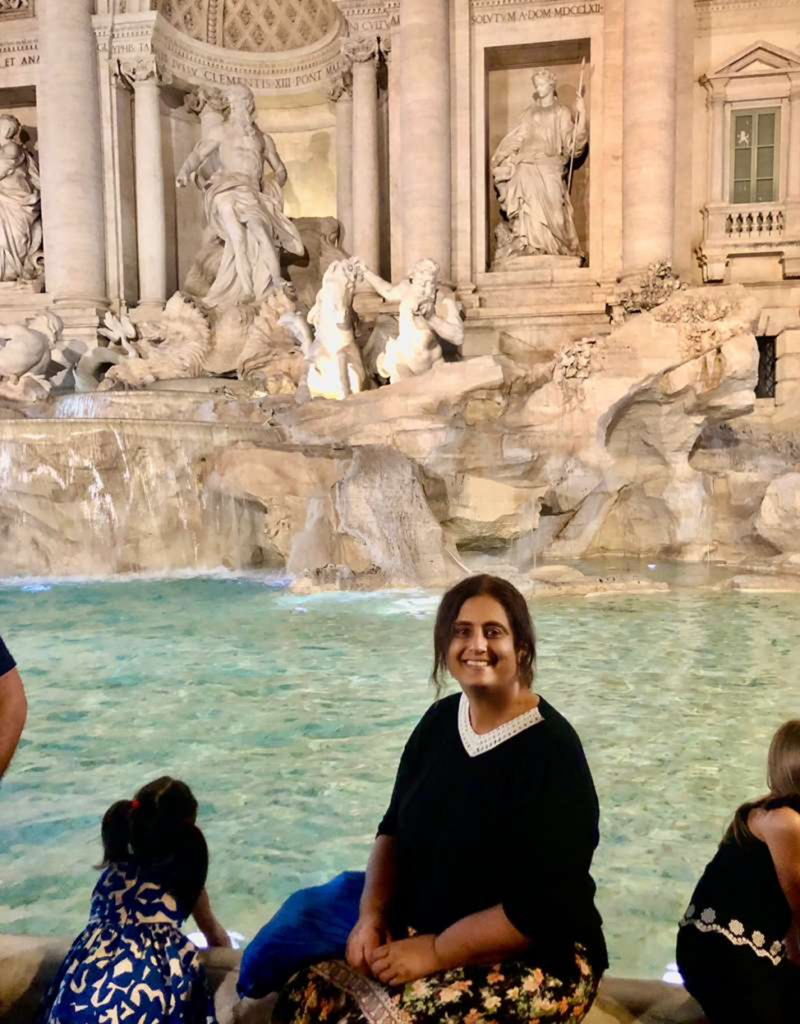
next morning, I had breakfast at Timothy Cafe, located below the hotel. As in other places, the buffet breakfast here was 10 euros. Then I walked to the Trevi Fountain. Although it was only 20 minutes away from the hotel, it took a little longer because I stopped to admire the surroundings. On the way, I watched the sunset from the hill where the palace in Monti Square is located. The area around the Trevi Fountain was very crowded. This was my fourth time here. I guess because I threw coins into the fountain each time I came, I was able to return to Rome. Despite the crowd, I managed to reach the edge of the pool and threw some coins into the fountain, wishing to come back again.
I met a young American couple and chatted with them. They had just finished high school and were traveling before starting college. They shared their memories of Italy. This fountain, which collects 1.5 million euros a year, was one of Rome’s most touristy spots. I waited a very long time for the bus. When it didn’t come, I walked back to the hotel. I had postponed my departure because there was a problem with my plane ticket.
The next morning, I had to move to another hotel because there was no room at the hotel where I was staying, and I walked to the nearby Torino Hotel. It was a historic antique hotel and had four stars. The man at the reception said he could give me the room at 2 p.m., so I sat down and rested for a while. Fortunately, they gave me my room early. When I turned on the TV, I saw a Turkish series called Kara Sevda. The actors were speaking Italian. Watching Turkish series on foreign television was no longer surprising. I had previously watched another series dubbed in Arabic in Morocco.
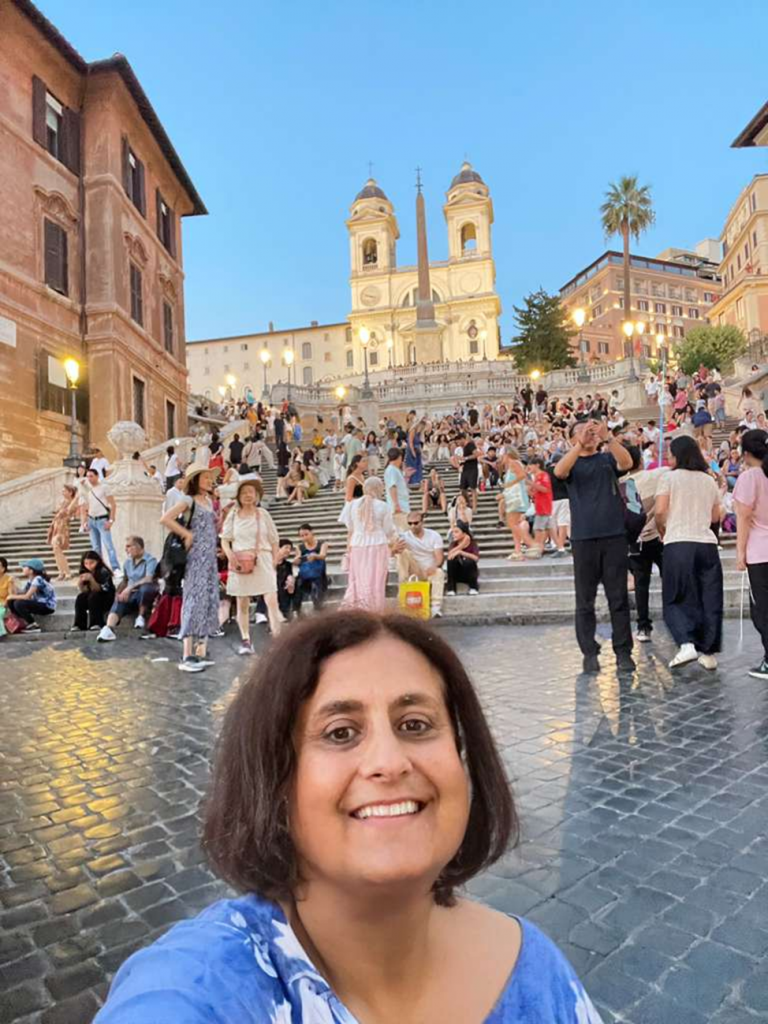
I went to a nearby Italian restaurant and ate lasagna. It was interesting that a tram passed right by my table, with only a flowered fence between us. Later, I bought a day ticket, took the A train, and arrived at the Spagna stop. I walked to the Spanish Steps. It was very crowded again. Even though sitting was prohibited in 2019, I saw people sitting on the steps enjoying the beauty, as there were no security guards around. I took off my flip-flops so I wouldn’t slip in the small fountain right in front of them and filled my bottle with water from the fountain. My advice to you is, if you go to Rome; carry an empty bottle with you. There are many fountains in the city. That way, you won’t have to buy water from the market. After drinking my water, I slowly climbed the steps and sat down for a while. At the top, there was a con artist doing a coin-tossing game to win money. I saw a woman fall for this tourist trap and put in 100 euros. The Trinità dei Monti Church at the top was closed because it was late. I went back down the Spanish Steps to the square and wandered around. I took the metro back to my hotel.
The next morning, I had my buffet breakfast on the hotel terrace. The birds eating the leftovers created an interesting scene, and from this terrace, it was possible to see Rome’s historical sites from above. I took the A train from Termini Station and got off at Ottaviano Station. Following the signs for Piazza San Pietro on Ottaviano Street, I reached the Vatican, the world’s smallest country. There was no passport control at the entrance, but there was a security check.
In St. Peter’s Square, there were two large pools facing each other and a number of Roman military statues on top of the columns. The Vatican, ruled by the Pope, the head of the Christian world, is the world’s smallest country with an area of 0.44 km² and a population of around 500. Pope Leo XIV took office after the death of Pope Francis. The city-state of the Vatican, which has the world’s richest collection of sculptures and paintings, is a pilgrimage center for Catholics.
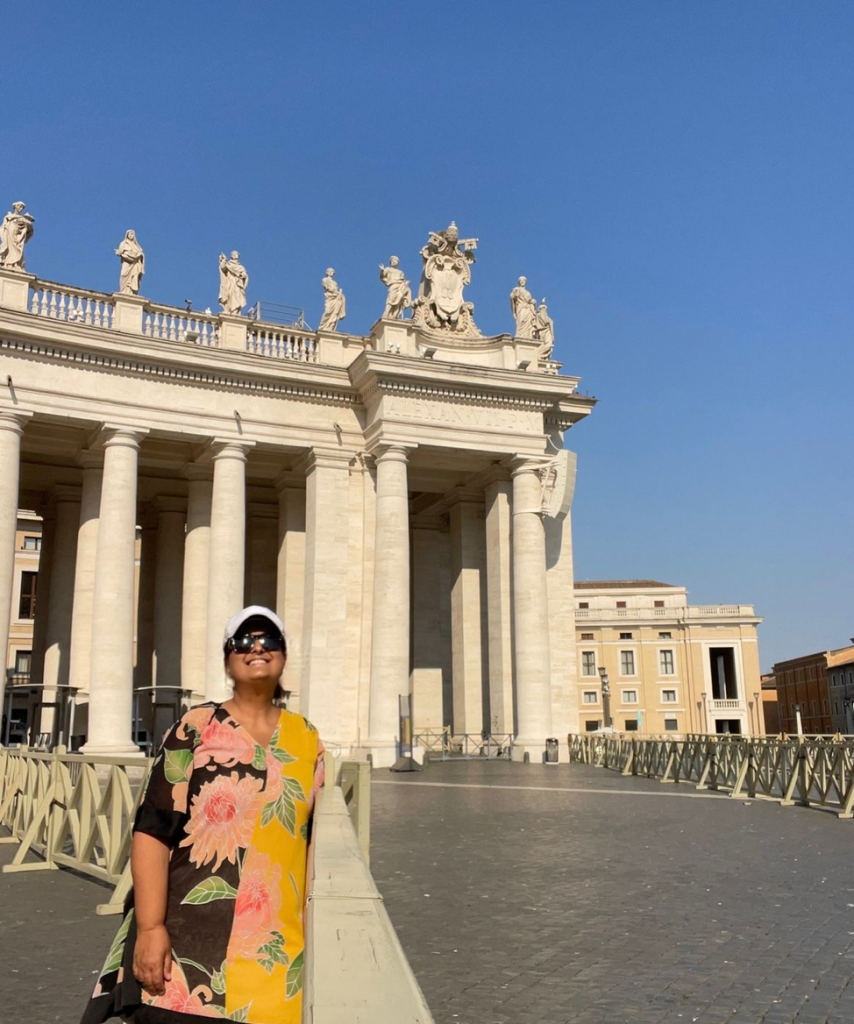
I waited in line to enter St. Peter’s Basilica. The artworks and the majestic appearance inside the basilica, which can be visited free, impressed me greatly. Since this is a religious temple, they do not allow entry in revealing clothing and distribute coverings at the door. Hundreds of chairs were set up inside and outside for the Sunday mass. The confessional booths caught my attention again, just as they did when I first came years ago. People were lining up and kneeling to confess their sins to the priest. The gift shop at the exit sold soaps, perfumes, and other souvenirs made there. I also had the chance to watch the changing of the guard by the Vatican soldiers in their striped, peculiar uniforms.
The “Unaware of Angels” statue, a replica of which I saw years ago in Miami, has been on display in the square since 2019. This statue depicts the hardships endured by immigrants and refugees and their centuries-long journeys. It also holds the distinction of being the first statue placed in St. Peter’s Square in 400 years. There were quite a few curious people around it. I also saw the Vatican post office and walked a long way to exit the Vatican borders.
I walked to the banks of the Tiber River and listened to musicians playing. I saw Castel Sant’Angelo. You can cross to the other side of the Tiber River via the Vittorio Emanuele II and Ponte Sant’Angelo bridges. I went to a restaurant called Pizzeria de Marco and had fettuccine there. While I’m at it, I’d like to mention the classification of restaurants in Italy. This will help you when making your choice.
Osteria – small places that started out as bars and now offer reasonably priced local dishes.
Trattoria – family-run businesses serving home-style cooking. They may be a little more expensive than Osteria.
Ristorante – an expensive place offering a wide variety of menus, including international cuisine.
Pizzeria – more reasonably priced, with a pizza-heavy menu.
Tavola Calda – offers fast food.
Agroturismo – farm restaurants.
Enoteca – wine houses.
Coperto refers to the mandatory “cover charge” or “tablecloth/seating fee” charged per person in Italian restaurants and cafes. This fee, which typically ranges from €1 to €5, is charged for the use of bread, cutlery, and tablecloths. This amount, which may also appear on the bill as “pane e coperto” (bread and cover charge), is a separate expense item, independent of the tip. In tourist areas, a service charge (servizio) of around 10–15% is added to the bill.
Food in Italy is delicious because organic products are used. I left feeling very satisfied with the fettuccine I had eaten and walked to Piazza Navona. I wandered around the square, famous for its artists, fountains, and statues, and then took the bus back to my hotel.
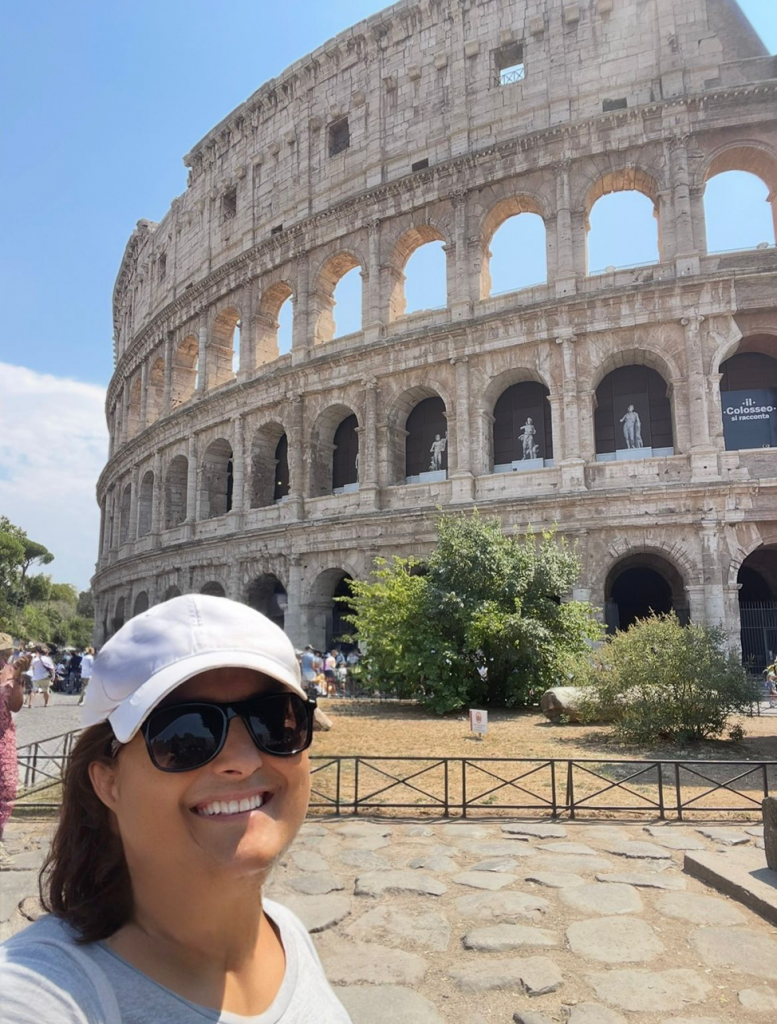
The next day, I started with breakfast on the terrace again. I checked out of the hotel, paying a city tax of 15 euros for two nights. Fortunately, the luggage storage here was free. I got off the B train at Colosseo Station. I saw the Colosseum, selected as one of the Seven Wonders of the World, for the third time. It was one of the hottest days of the year. Despite this, there were many tourists. In fact, this year a tour guide had died from heatstroke.
There was a long line again in front of the Roman ruins. It was also possible to see the historical remains in the Forum while walking down the street. I visited the Basilica di Santa Francesca Romana, which was free to enter. While walking down the street, I saw four large maps on the walls. One showed that the Roman Empire once included Turkish territory and that its capital was Istanbul.
I walked to the Victor Emmanuel II monument and then turned back because I had to catch my flight. I picked up my suitcase from the hotel and went to Termini Station. Since the barcode on my online ticket wouldn’t scan, I paid with my credit card. I ended up paying twice for the train. For this reason, I recommend using a credit card to board instead of buying tickets in advance, because other people had quite a bit of trouble scanning the barcodes on tickets purchased in advance.
I checked in at the Air France Business Class section at Rome Fiumicino Airport. When Delta canceled my ticket, they upgraded me and charged the difference, citing a lack of seats in economy. Using the business class lounge during the layover in Paris and receiving special service on the plane, along with generous refreshments, was nice, but the best part was the fast-track access without having to join the regular lines.
Dolce Vita means “sweet life” in Italian and life in Italy truly fits this description. Of course, as everywhere else, there may be difficulties and hardships, but with their Mediterranean positivity and cheerfulness, Italians know how to enjoy life. Add to that the healthy food that won’t make you gain weight no matter how much you eat, and their unique sense of fun, and Italy is a country worth visiting and seeing. What’s more, visiting Italy once is not enough. You’ll want to go back again and again. In short, Italy offers its visitors a wonderful experience.
Therefore, I spent a week in Italy visiting three cities. In addition to Milan, Florence, and Rome, I also visited Lugano in Switzerland and the Vatican, the world’s smallest country. I also wrote about my memories of Venice on my way back from Istanbul. Don’t forget to read that one too.
I look forward to your comments and questions.
Your Traveler Friend,
Canan
Canan’cım harika bir gezi notları. Ellerine sağlık. Okurken seninle beraber o anları yaşadım. 😊
Teşekkür ederim
Canancığım harikasın Yıllar önceki anılarımız canlandı:))